Wireless microphones changed the stage
The industry quickly accepted that wireless could be just as dependable as a cable for the most important audio source on stage: the performer's voice (and then later on for electric pickup instruments). Wireless microphone systems became standard because they proved that properly deployed RF systems can reliably carry mission-critical audio night after night.
Just as we trust RF to carry a lead vocal from the stage to the mix position, those same proven RF principles can be applied to delivering audio to remote PA speakers.
Traditional: Audio Source → Cable → Mixer
Wireless: Audio Source → Wireless Transmitter → RF Link → Wireless Receiver → Mixer
The result:
- Greater flexibility
- Faster setup
- Cleaner stages
- Fewer trip hazards
- Better performer mobility
IEM systems did the same for monitoring
Wireless IEM systems further solidified this trust by replacing monitor floor wedges with RF links. Musicians rely on these systems for their entire performance experience. Because professionals trust the consistency and quality of RF for monitoring, extending that trust to the PA system is the next logical step in a professional workflow.
Benefits include:
- Reduced stage clutter with fewer components (12 gauge speakon wire and separate amplifiers in the case of passive floor wedges)
- Faster deployment
- Greater performer mobility
- Cleaner signal routing
- Lower stage volume, improved gain-before-feedback, and more consistent monitor mixes
Today, wireless In-Ear monitoring is considered standard practice at countless live events.
So why are we still running hundreds of feet of XLR cable to delay speakers?
In many cases, it's simply because that's how it's always been done. Note that PA Extension Kit systems are designed for active speakers (line level, not passive) and typically deployed with portable PA “speakers on sticks” and many larger delay tower systems often require network and more complex configurations.
When additional audience coverage is needed, many systems still rely on wired distribution.
A typical outdoor event might require:
- 300 feet of cable to Delay Tower 1
- 500 feet of cable to Delay Tower 2
- 700 feet of cable to Delay Tower 3
Every additional speaker location means:
- More labor
- More setup time
- More cable management
- More opportunities for damage or failure
- More trip hazards
Ironically, while performers and monitor mixes have gone wireless, active remote PA speaker drops often remain stuck in a wired workflow with line level XLR cables.
Building trust in your portable PA system
Trust is built on using the right tool for the job. While some professionals have used "workaround" solutions—repurposing IEM or microphone systems to send signals to speakers—the RF PA Extension Kit is purpose-built for active line-level PA signals. This eliminates common challenges such as signal-path limitations, complex receiver management, and limited scalability that can arise when repurposing equipment for PA distribution.
By removing the hundreds of feet of cable between the mixer and the active remote speaker, you aren't just saving labor; you're eliminating many physical failure points associated with long cable runs, such as damaged connectors, chances of 60Hz hum/buzz. And worse, trip hazards. The RF PA Extension Kit replaces the long XLR run with a dedicated, high-quality UHF audio link designed specifically for line-level PA distribution.
Traditional Delay Speaker Signal Path: Mixer → Hundreds of Feet of XLR Cable → Delay Speaker
Wireless Delay Speaker Signal Path: Mixer → PA Transmitter → RF Link → PA Receiver → Powered Speaker
The concept is familiar because audio professionals already trust it every day. The only thing changing is the destination. Here is an example showing the popular Electro-Voice EVERSE series:
The industry's wireless journey
From wireless microphones in the 80s–90s, to IEM adoption in the 2000s, RF has steadily become standard in live production workflows.
Real-world example: Outdoor Festival
Imagine an audience area extending hundreds of feet beyond the main PA. Check out howRevelation Productions provided feeds to satellite PA systems using RF PA Extension Kit.
Traditionally:
- Main PA at stage
- Delay Tower 1 fed with 300 feet of cable
- Delay Tower 2 fed with 500 feet of cable
- Delay Tower 3 fed with 700 feet of cable
With wireless PA distribution:
- Main PA remains wired at stage
- Remote speaker towers receive audio wirelessly
- No inter-zone audio cabling required
- Setup time drops significantly
- The strike/tear down process becomes dramatically faster
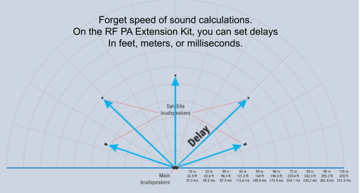
Each RF PA receiver can be independently delayed, allowing every tower position to be time-aligned without additional processing hardware. The result is cleaner deployment with fewer obstacles for staff, vendors, and attendees.
Built for professional audio workflows
Wireless PA distribution isn't trying to reinvent live sound. It's applying the same RF concepts already proven by wireless microphones and IEM systems to another part of the signal chain.
The RF PA Extension Kit was designed specifically for this application, combining the flexibility of wireless with the performance expectations of professional sound reinforcement.
RF PA Extension Kit features include:
- A single RF PA transmitter can distribute audio to multiple receiver locations
- Built-in delay adjustment at every receiver for precise loudspeaker alignment
- Professional balanced audio inputs and outputs
- Low system latency suitable for live sound reinforcement applications
- Rapid deployment for temporary events
Using Wireless Mics or IEMs for “Wireless PA”
This is a common workaround, but it’s not what those systems are designed for. Wireless microphones and IEM systems are built for performer audio paths (mic → console, or console → ears), not for distributing full PA program audio to speakers.
While some audio professionals have adapted existing wireless systems to fill this role, and some plug-on mic transmitters can accept line-level signals, these products were generally designed for performer audio workflows rather than PA distribution.
- Wireless mic limitations: While some mic system plug on transmitters can accept line-level signals, most wireless mic products are optimized for performer audio workflows rather than PA distribution
- Wireless IEM limitations: Intended for personal monitor mixes delivered to individual bodypacks, not scalable PA zone distribution.
- IEM Bodypack receivers occasionally provide “line-ish” output levels, but still not standard +4 dBu balanced line outputs like a mixer or DSP
- Not scalable for zones: Each PA speaker typically requires its own receiver chain
- Point-to-point mindset: Not designed as a multi-zone distribution architecture
- Operational complexity: More receivers, more tuning, more RF coordination
- Additional configuration considerations may arise when adapting systems for applications they were not originally designed to support.
- Most IEM receivers do not provide diversity reception
In short: it works in a pinch, but it’s a “repurposed” solution.
Why not use a Wi-Fi based solution?
Professional PA distribution requires predictable performance and low latency.
Unlike Wi-Fi-based audio transport systems that share bandwidth with network traffic, professional RF audio systems are designed specifically for deterministic, low-latency live sound transmission.
Purpose-Built for Wireless PA Distribution
RF PA Extension Kit is designed specifically to solve this exact problem: getting PA audio to multiple speaker locations without copper runs.
- Line-level audio distribution over RF (purpose-built for PA signal, not mic/earphone level)
- Consistent high quality sound across all PA speaker zones
- Scalable for multiple speaker positions or areas
- Agnostic integration with existing mixers, DSPs, and PA systems
- Cleaner deployment model: fewer cable runs, fewer failure points, faster setup
- Predictable performance in temporary and installed environments
Your next logical step
The live sound industry has already embraced wireless for performers and monitors. If it makes sense to remove the cable between the performer and the mixer—and between the mixer and the performer—it also makes sense to remove the cable between the mixer and remote speakers.
The result is exactly what every production team is looking for:
-
Less Cable.
-
Faster Setup.
-
Cleaner Venues.
-
Reliable Coverage.
The industry has spent decades proving that properly deployed RF systems can be trusted for mission-critical audio. Wireless PA distribution simply extends that trust to loudspeaker deployment—eliminating cable runs, reducing setup time, and delivering professional audio where it's needed most.
Less cable. More coverage. Same trusted RF principles.