Church tech teams love gear that sounds “bigger” or “better.” Words like active, powered, and boosted just seem like upgrades. And since wireless mics and IEMs are mission-critical in worship, it’s natural to pick whatever sounds strongest. But here’s the truth:
An “active” antenna isn’t automatically better. Used incorrectly, it can make things much worse for your church.
So let’s slow down, learn what antennas actually do, and talk about when to use active antennas — and when NOT to.
What is a Passive Antenna?
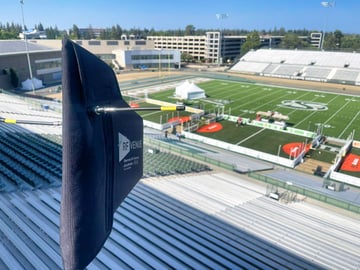
A passive antenna is simply that — an antenna. It receives or transmits signals with no built-in amplifier. RF Venue has several directional passive antennas that are very popular with churches. Each has its own specialty to fit different sizes and coverage area in worship spaces:
Passive antennas are what most churches need.
What is an Active Antenna?
An active antenna does exactly what a passive one does plus it has an amplifier built into it. People hear “amplifier” and think it means “stronger” or “better,” but that’s not how wireless systems work.
Active antennas do NOT pull in more signals or increase reception quality.
They simply increase and boost the signal after it leaves the antenna, usually to help with long cable runs.
When Should a Church Use an Active Antenna?
Use an active antenna only when you need to make up for signal loss in extra-long cable runs. Different coax cable types have different signal loss specs. An active antenna can boost the signal to help with signal loss because of distance. That’s the only real reason to use an active antenna in most church systems. Contact one of our experts to help you with specifics on signal loss with different coax cable types.
When Shouldn’t a Church Use an Active Antenna?
Most churches have short cable runs — usually 25–50 feet between the antenna and the wireless rack. If you amplify a short run, you can overload the receiver and create static and dropouts.
Real-world example:
A pastor’s mic keeps exploding with loud noise every time they walk near the stage edge.
Everything looks great — new batteries, good mic, strong IEMs — but the real cause is a boosted antenna flooding the receiver with too much RF.
The signal is literally “too loud” in the wireless world. Turning up more actually makes it worse. As an analogy, think about a sound console channel. If you turn up the gain past what you need, the channel peaks and the sound is distorted and breaks up. The signal is literally “too loud”. Too amplified.
“But Active Must Be Better… Right?”
If you boost a signal that doesn’t need boosting, you don’t make it better — you break it. Many churches accidentally do this when they buy an active “paddle” antenna and set it to +6 dB or +12 dB, “just to be safe” even though they’re only running 25–50 ft of cable.
Some big name companies push active antenna sales. So it’s easy for church techs to believe that active antennas are powered, boosted, better. But truthfully, they are a specific tool to use when amplification is needed for long cable runs. Most church wireless systems work better with less expensive passive antennas or RF Venue Diversity antennas (two antennas in one)
Remember:
Directional antennas (like CP Beam, Diversity Fin, Diversity Architectural, CP Stage) already add gain naturally by directionality. So adding an amplifier on top of that is asking for overload.
NEVER Use Active Antennas on IEM Transmitters
Increasing power on IEMs (in-ear monitor transmitters) can:
- Break FCC rules for unlicensed transmitters
- Cause interference with other wireless devices in your building
- Increase dropouts instead of fixing them
- Damage receivers if overpowered
Church rule of thumb: Never add an active antenna to a transmitting device such as IEMs or intercoms.
The Smart Church Strategy
✔️ Use passive antennas for almost all churches
✔️ Only add amplification if your cable run is over 100 ft (depending on your cable type)
✔️ Never amplify IEM transmit antennas
✔️ Remember that antenna placement matters more than power
✔️ If you NEED amplification, RF Venue has an inexpensive in line amplifier you can add to your cable
run with your existing passive antenna