Ask a group of audio engineers: “Raise your hand if you love mixing live shows.” Hands everywhere go up.
Now ask, “Who likes to lay and tape hundreds of feet of cables and tape them down? And then peel up the tape and coil up the cables after the show?” Hands go back down.
And “Who likes pulling cable through conduit that’s already nearly full? Or finding there is no conduit to pull through?” Audio engineers head for the doors.
It’s common for PA systems to cover large areas that a single central loudspeaker system can’t suitably address. They require satellite loudspeakers with delay so they coincide with the main system and/or loudspeakers in remote rooms within the venue. The traditional way has been to run audio signals through cables run from the main system to where the satellite and auxiliary loudspeakers lie.
It's also common for PA systems to require extension to a venue’s auxiliary spaces, like the green room, the lobby, etc. Maybe there is space to run cabling through conduits or plenums … or maybe not, especially in older buildings.
Running cables some distance, taping and securing them, and maybe even running them through cable ramps is a time-consuming chore that no one enjoys. So is running new signal wiring through a facility. Wouldn’t it be great to set up a system without all that time and material?
A Solution That Simplifies
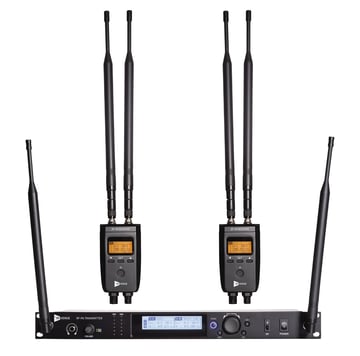
The RF Venue RF PA Extension Kit brings a level of ease and simplicity to these tasks. The kit comprises a two-channel UHF transmitter unit along with the desired number of small diversity IP54 rated receivers. The transmitter unit has two independent RF transmitters that can be set to operate in the 470 to 506 MHz range. Each one has a line-level audio input with a hard-wired pass-through, so the transmitter needs no repatching in the rack when it’s not in use. The two audio channels can be a left-right stereo pair, or just two audio programs.
The receivers are full diversity and tunable, and they feature onboard digital delay, up to 800 milliseconds, that can be set in feet, meters, or milliseconds. You can thus avoid getting tripped up by speed-of-sound calculations when setting up delay towers or fills. But that never happens, right? Each transmitter channel may
You can set the tuning frequency and delay right on the receivers. You can also set the parameters of up to four receivers at the front panel of the transmitter unit; a 2.4 GHz sync signal sends the setup to the receivers. Configure additional receivers manually.
Example 1 — Extend PA to Other Rooms
Let’s look at the tremendous flexibility this system offers. Figure 1 is a multi-purpose theater. It has a house sound system, but management wants to bring the house sound backstage to the dressing and green rooms, as well as out front to the lobby. The venue also has added front fill loudspeakers along the stage apron so that patrons not covered by the center cluster overhead may enjoy great sound.
If the venue is old, the labor and materials involved in running the signal cabling alone could be a very costly undertaking. But the RF PA EXTENSION KIT eliminates the need to run cables from front of house, instead sending the audio via high-quality analog FM. The lobby and backstage feeds could be sent on one RF channel, while the front fills will need a different EQ, so they’re on their own channel.
The dressing and green room loudspeakers could be split from the same receiver, or each on their own, depending on the limitations imposed by the structure. The amp for the lobby loudspeakers would also be fed from a receiver. No delay should be necessary for these loudspeakers.
The front fill loudspeakers would get their audio from another receiver. They might require some delay to avoid audible effects where they and the center cluster overlap.
Example 2 — Set Up Satellite Delay Systems With Ease
Figure 2 depicts an outdoor left-right live concert system with several satellite systems of delay loudspeakers to cover a large area while maintaining reasonable sound levels. The delay is necessary to make the sound from the satellite loudspeakers coincident with the sound from the main loudspeaker system.
Previously, this had to be done with multiple bus feeds from front of house, a separate one for each delay, mix, EQ, or other setting. This system is designed to have a separate left-right, so the delays are also separated into left and right.
Wiring the satellites would require hundreds of feet of cable along with requisite rolls of gaffer’s tape to prevent trip hazards. And if the location happens to be on a grass or gravel surface, you’d probably need a lot of cable ramps instead of tape. A wired approach would require many, many hours of labor in both setup and strike.
Before the RF PA Extension Kit, a wireless solution usually took the form of jerry-rigging a bunch of IEM systems as in Figure 3. This saved the labor and materials of using cables, but it was still complicated because of the number of bus feeds and delay settings required. This example uses feeds six buses, each with its own delay setting.
Let’s move on to Figure 4. Note that in this system, the RF-PA Extension Kit offers a greatly simplified solution because we only need the left and right audio feeds, which we’ll call Audio 1 and Audio 2. The delay settings are set in the receivers themselves, and we set the receive frequencies to the ones set in the transmitter for Audio 1 and Audio 2. Not only is physical setup and teardown much quicker and easier, but system configuration is also much quicker and easier.
The RF Venue RF PA Extension Kit debuted at INFOCOMM 2025 and was immediately well received by customers. The basic kit (SKU RF-PA-KIT) contains the two-channel transmitter unit, two receivers, omnidirectional half-wave dipole whip antennas, power supplies, audio and power cables, and mounting accessories. The RF-PA-8PACK features eight receivers. Receivers are also available individually.